The AI in Education and Careers
Introduction
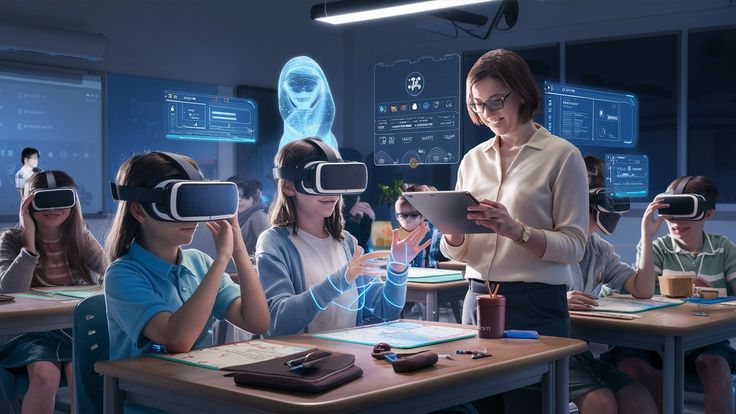
Artificial Intelligence (AI) is among the most revolutionary technologies of the 21st century. From tailored shopping suggestions to autonomous automobiles, AI is shaping nearly every area of our lives. In education and employment, its impact is particularly striking. AI is no longer a science fiction concept; it is presently transforming the way pupils learn, teachers instruct, and experts develop their careers.
In this article, we’ll explore how AI is transforming education, its role in career development, the challenges it brings, and the exciting opportunities it opens for students, educators, and professionals.
What is Artificial Intelligence (AI)?
Artificial Intelligence is the imitation of human intelligence in machines. These machines are created to learn, reason, adapt, and execute tasks that typically demand human intelligence—like problem-solving, decision-making, and pattern recognition. In education and employment, AI is used for:
- Automation of tasks (grading, scheduling, candidate screening)
- Personalized learning experiences
- Career suggestions and job matching
- Skill acquisition via AI-enabled platforms
AI in Education – Transforming the Learning Experience
- Personalized Learning: Classrooms traditionally adopt a “one-size-fits-all” model, yet all students have individual learning speeds and modes. Artificially intelligent tools such as adaptive learning software monitor student performance and devise personalized lesson plans. For instance, if a student is having trouble with mathematics, the system gives additional practice problems and step-by-step solutions.
- Intelligent Tutoring Systems: Virtual AI-powered tutors can assist students 24/7. AI-enabled tools such as Chatbots, Duolingo AI tutors, and Coursera’s AI assistants assist learners in getting doubts cleared immediately. This minimizes the reliance on learning-only classrooms.
- Automated Administrative Tasks: Educators spend much of their time on grading, attendance, and paperwork. AI software grades multiple-choice tests automatically, monitors attendance electronically, and even grades assignments to a certain level. This enables teachers to spend more time on instruction and mentoring.
- Data-Driven Insights: AI is capable of examining student performance data and detecting patterns. For instance, when a student’s grades are going down, AI informs teachers and parents in advance, and intervention can be made promptly. Universities employ AI analytics to enhance curriculum planning and pedagogy.
- Virtual Classrooms & Learning Accessibility: AI facilitates online and distance learning using tools such as Zoom, Microsoft Teams, and AI-powered Learning Management Systems (LMS). This provides students in remote or rural areas with access to quality education. Speech recognition and translation software based on AI also assist students with disabilities or language differences.
AI in Career Development
- Career Guidance & Counseling: Career counseling software powered by AI review a student’s abilities, passions, and grades to recommend appropriate professions. For instance, LinkedIn Learning and Coursera leverage AI to recommend skill-oriented courses based on demand in the market.
- Resume Screening & Recruitment: Organizations employ AI-driven Applicant Tracking Systems (ATS) to scan resumes and narrow down candidates. This is time-saving and equitable in hiring by minimizing human bias.
- Job Matching: AI-powered platforms scan job postings and compare them to candidate profiles. Job sites such as Indeed, Naukri, and Glassdoor employ AI technology to suggest jobs based on a candidate’s qualifications and experience.
- Upskilling and Reskilling: With today’s ever-evolving job market, constant learning is essential. AI-facilitated learning platforms suggest courses aligned with current trends. For instance, if data science expertise is in demand, AI platforms suggest suitable certifications to professionals.
- Soft Skills Training: Interview prep, communication skill development, and leadership training are also facilitated by AI tools. Virtual simulations enable candidates to rehearse actual-case scenarios with immediate AI-based feedback.
Real-World Examples of AI in Education and Careers
Duolingo – AI-powered language learning app that offers customized lessons to every student.
Coursera & Udemy – Employ AI for suggesting career-oriented courses.
Grammarly – AI-powered writing assistant with general usage by students and professionals.
LinkedIn – Employs AI for job suggestions, networking experiences, and skill enhancement routes.
Unacademy & Byju’s – Employ AI for adaptive education and customized student learning.
Benefits of AI in Education and Careers
Personalized learning improves academic performance.
Accessibility makes education available to remote learners.
Time-saving automation helps teachers and HR professionals focus on critical tasks.
Career readiness through up-to-date skill development.
Efficient recruitment with AI-powered candidate screening.
Challenges of AI in Education and Careers
- High implementation cost – AI applications might be costly to schools and small organizations.
- Digital divide – Those without internet connectivity or devices will risk being left behind.
- Job displacement – Certain administrative and repetitive jobs can be taken over by AI.
- Data privacy issues – Gathering and holding student or worker data becomes a security threat.
- Technological over-reliance – Interhuman contact in learning and guidance can reduce.
The Future of AI in Education and Careers
- Smart classrooms with teaching assistants powered by AI.
- Lifelong learning systems providing customized career development paths.
- AI career mentors to steer professionals all through their careers.
- Hybrid model of learning integrating classroom instruction with AI-enabled online resources.
- AI recruitment for ensuring equitable and skill-based hiring across sectors.
Conclusion
Artificial Intelligence is no longer in the realm of a buzzword anymore—it is changing the means of learning, teaching, and working. In education, AI guarantees that students are given personalized, inclusive, and interactive learning experiences. In the workforce, it makes professionals competitive by providing assistance, upskilling, and streamlined recruitment processes.
While the pitfalls of cost, data privacy, and job loss are real, the advantages of AI are enormous. The future is for those who can get used to change, keep learning, and make use of AI as an ally in progress.
For pupils and professionals, adopting AI is no longer a choice—it is a necessity to succeed in the changing landscape of work and education.